Why map the arbitrum perp landscape
The Arbitrum perpetual futures market is not a single exchange. It is a fragmented network of protocols, each holding its own liquidity pools, order books, and settlement mechanisms. If you treat this ecosystem as a monolith, you will pay for it in slippage and missed execution opportunities.
Liquidity on Arbitrum is unevenly distributed. Some protocols dominate specific asset classes, while others serve niche strategies. Without a structured map, you are trading blind. You might route a large order through a venue with thin depth, causing significant price impact, or miss a better price on a competing platform that simply didn't appear in your initial search.
Mapping the landscape means identifying where the real volume lives. It involves understanding which protocols offer tight spreads for major pairs like ETH or BTC, and which venues provide the best leverage ratios for altcoins. This clarity allows you to choose the right tool for the right trade, minimizing costs and maximizing efficiency.
To see the broader market context that drives these perp volumes, look at the current ETH price action. Arbitrum's activity is closely tied to Ethereum's momentum, but the specific perp venues react with unique latency and depth characteristics.
A proper map helps you avoid the common trap of liquidity fragmentation. By knowing which protocols are active and where the capital is concentrated, you can execute trades with precision rather than guesswork. This is not about finding the "best" exchange in a vacuum; it is about finding the best venue for your specific trade parameters at this specific moment.
The Technical Backbone
Perpetual futures on Arbitrum rely on a specific stack of infrastructure that separates them from spot trading. Understanding how these layers interact is essential for mapping risk and latency in your trading strategy.
At the core is the rollup technology. Arbitrum One uses optimistic rollups, processing transactions on a sidechain while relying on Ethereum for final settlement. This design prioritizes security and compatibility with the broader Ethereum ecosystem, making it the primary home for high-value perp DEXs. Arbitrum Nova, by contrast, uses AnyTrust technology. It trades some decentralization for significantly lower latency and cost, catering to high-frequency trading applications that need speed over absolute security guarantees.
Oracles and bridges form the connective tissue of this ecosystem. Price oracles feed real-time data to smart contracts, ensuring that liquidations and funding rates reflect actual market conditions. Bridges move assets between Ethereum mainnet and Arbitrum, acting as the entry and exit points for liquidity. The distinction between One and Nova matters here: assets must be routed to the correct chain to interact with the intended perp protocol.
Leading perp DEX protocols
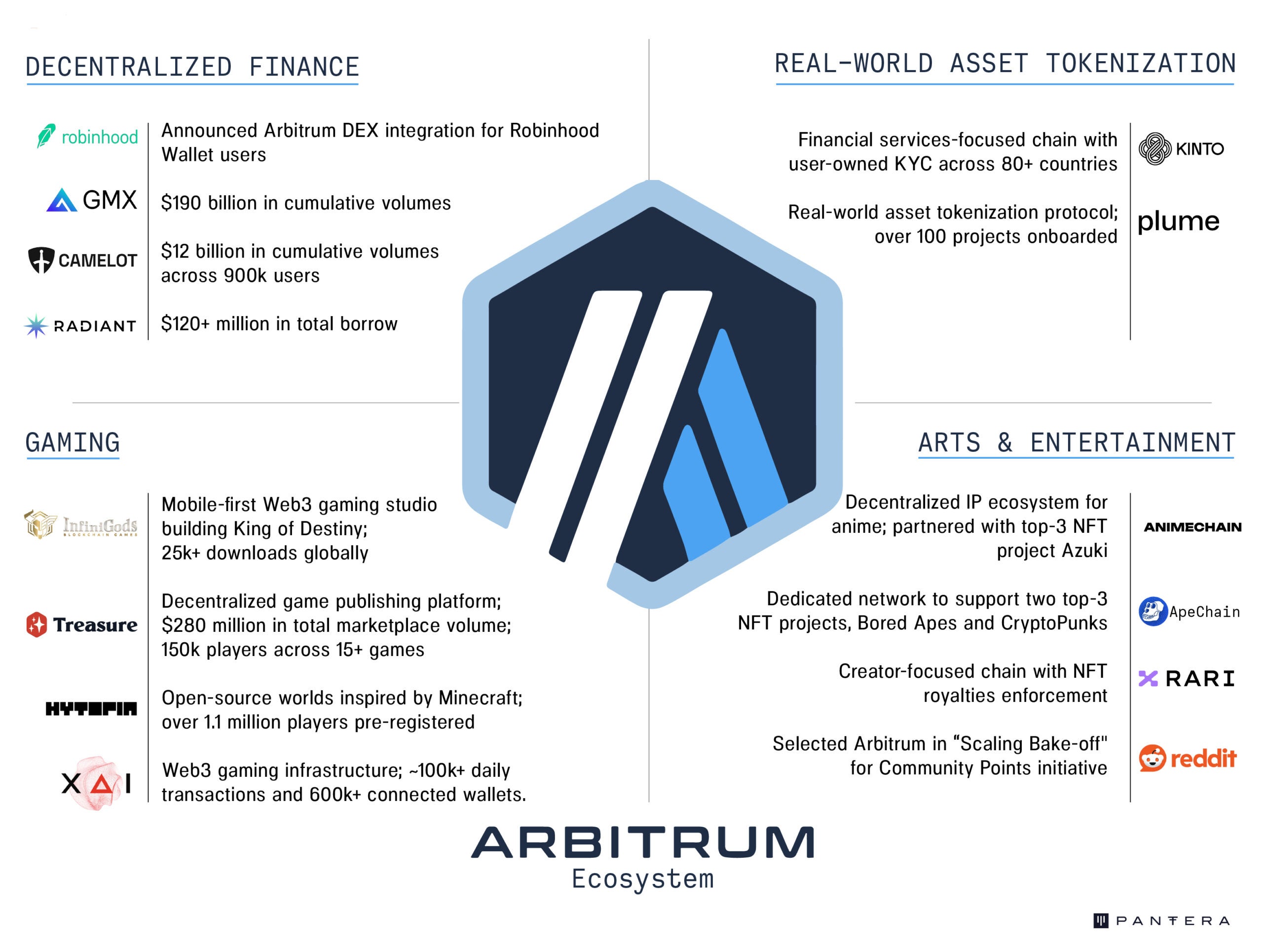
Arbitrum has become the primary hub for decentralized perpetual trading, hosting a diverse range of protocols that serve different risk appetites and trading styles. While the space is crowded, a few key players dominate the landscape by offering distinct architectural advantages.
GMX: The Liquidity Provider Standard
GMX remains the most established perpetual DEX on Arbitrum, known for its GLP pool model. It offers deep liquidity for major assets like BTC and ETH with minimal slippage. The protocol’s unique value proposition lies in its ability to provide low fees and high leverage (up to 50x) while relying on a diversified pool of assets as collateral. For traders seeking stability and deep order books, GMX is the default choice.
Gains Network: Synthetic Assets and High Leverage
Gains Network (gTrade) distinguishes itself by offering trading on synthetic assets, including forex, commodities, and indices, alongside crypto. It supports leverage up to 150x, appealing to traders who want exposure beyond traditional crypto markets. The protocol uses a proprietary oracle system and a vault-based model, making it a strong alternative for those looking to diversify their trading instruments without leaving the decentralized space.
Hyperliquid: The High-Performance Bridge
While Hyperliquid operates its own L1, its bridge to Arbitrum allows users to access its high-speed, low-latency trading engine. It is designed for high-frequency traders who prioritize execution speed over the multi-chain flexibility of other protocols. Hyperliquid’s on-chain order book model provides a centralized exchange-like experience, making it a top pick for active traders who demand precision and speed.
Protocol Comparison
The table below compares the core metrics of these leading platforms to help you choose the right tool for your strategy.
| Protocol | Max Leverage | Primary Assets | Oracle Type |
|---|---|---|---|
| GMX | 50x | Crypto (BTC, ETH, etc.) | Chainlink + TWAP |
| Gains Network | 150x | Crypto, Forex, Indices | Proprietary + Chainlink |
| Hyperliquid | 50x | Crypto (via Bridge) | Native L1 Oracle |
Market Context
Understanding the current market conditions is essential when selecting a perp DEX. The following chart shows the recent performance of ETH, a primary trading pair on most of these platforms.
Execution strategy and risk
Navigating the Arbitrum perpetual DEX landscape requires more than just capital; it demands a precise understanding of how these protocols interact with the broader ecosystem. As noted in Arbitrum Foundation ecosystem recommendations, identifying where capital is underweight or overexposed is critical for strategic positioning. Your execution strategy should mirror this mapping, treating each protocol not as an isolated entity but as a node in a larger network of liquidity and risk.
Check oracle latency before trading
Perpetual DEXs rely on oracles for price feeds, and latency can be a silent killer during high-volatility events. A delay in price updates can lead to unfavorable mark prices or unexpected liquidations. Before entering a position, verify the oracle's health and update frequency for your specific asset. Most leading protocols publish their oracle sources and update mechanisms in their documentation. If the oracle is lagging, consider widening your stop-loss or reducing position size to account for potential slippage.
Manage slippage with limit orders
Slippage on Arbitrum is generally low due to high throughput, but it can spike during market stress or when trading deep out-of-the-money options. Avoid using market orders for large positions. Instead, use limit orders to ensure you get the price you want. If you must use market orders, break them into smaller chunks to avoid moving the market against yourself. This is especially important when trading across multiple protocols, as liquidity fragmentation can exacerbate slippage.
Identify cross-protocol arbitrage
Cross-protocol arbitrage opportunities arise when price discrepancies exist between different perpetual DEXs on Arbitrum. These gaps are often short-lived, requiring fast execution and low-latency infrastructure. Monitor the price feeds of major protocols like GMX, Jupiter, or others in the ecosystem. If you spot a significant deviation, act quickly. However, be cautious of transaction costs and potential oracle manipulation. Always verify the price discrepancy with an independent source before executing.
Use provider-backed data for decisions
Relying on live, provider-backed data is essential for accurate execution. Static prices can be misleading, especially in a fast-moving DeFi environment. Use tools like TradingView or official protocol dashboards to get real-time data. This ensures your decisions are based on the most current market conditions, reducing the risk of acting on stale information.
Check the oracle update frequency and source for your chosen asset. Look for any known delays or issues in the protocol's documentation or community forums.
Break down large trades into smaller limit orders to minimize slippage. This is particularly important during high volatility or when trading less liquid assets.
Use real-time data feeds to identify price discrepancies between protocols. Act quickly but verify the gap with an independent source to avoid false signals.
| Protocol | Oracle Source | Avg Latency (ms) |
|---|---|---|
| GMX | Chainlink + Aggregators | ~200 |
| Morpho | Chainlink | ~150 |
| Camelot | Custom + Chainlink | ~180 |
Essential tools for traders
Monitoring the Arbitrum ecosystem requires a stack of specialized software. You cannot rely on generic DeFi dashboards alone. The network’s dual-chain structure—Arbitrum One and Arbitrum Nova—demands tools that can parse distinct block explorers and liquidity pools accurately.
Start with Arbitrum Portal as your central hub. It provides verified links to official bridges, governance resources, and technical documentation. Using the official portal reduces the risk of interacting with phishing sites or outdated bridge contracts. For deeper analytics, platforms like Dune or Nansen offer granular visibility into on-chain activity, though they often require a subscription for full feature sets.
Your wallet is your primary interface. Ensure it supports EIP-1559 transactions and has native gas token management for Arbitrum’s fee market. While software wallets work for active trading, consider hardware wallets for long-term holdings to secure your private keys offline.

As an Amazon Associate, we may earn from qualifying purchases.
No comments yet. Be the first to share your thoughts!